

Palatal distraction
Lasting widening of a narrow palate in adults: bite, smile and nasal breathing.
Duration
45 minutes to 1.5 hours
Anaesthesia
Usually general anaesthesia
Hospital stay
Day case or one night
Recovery
1 to 3 weeks off social activities, bone consolidation in 3 to 6 months
A narrow palate is not only a lack of space for the teeth. It often leads to a crossbite, crowded teeth, a narrow smile with dark spaces at the corners, and may come with difficult nasal breathing.
In adults, the suture in the middle of the palate has fused: an orthodontic appliance alone then mainly tips the teeth without widening the bone. Surgically assisted palatal distraction releases the bony resistance through minimally invasive surgery, then gradually widens the palate with an expander, for a skeletal and stable result.
Dr Afshin Yousefpour has performed palatal distraction for many years. He developed particular expertise in this surgery in the United Kingdom, in leading hospital maxillofacial units, and now offers it to his patients in Waterloo, in close cooperation with their orthodontists.
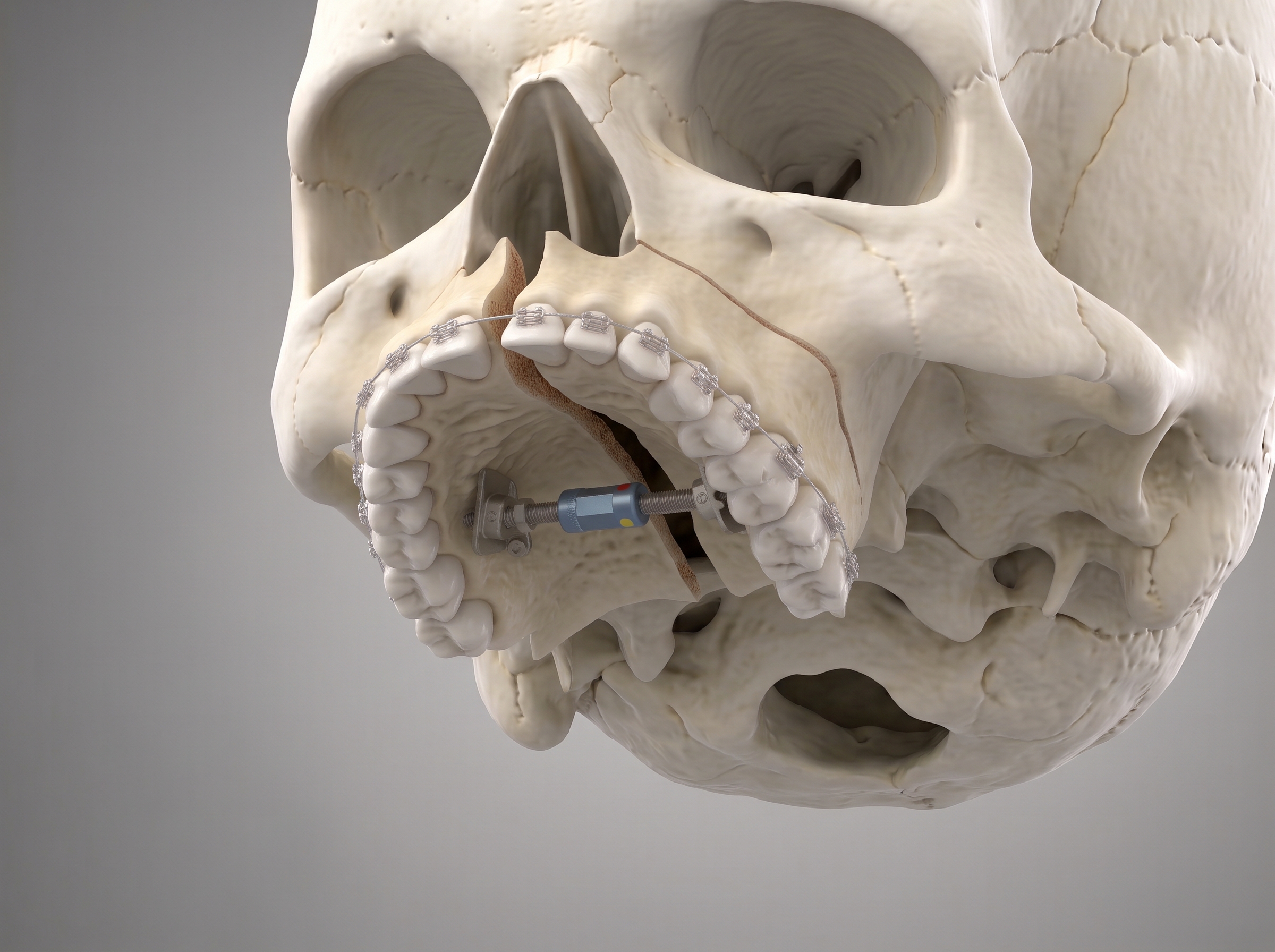
The protocol, step by step.
- Step 1
Assessment with your orthodontist
Clinical examination, bite analysis and a 3D scan (CBCT) to measure the transverse deficiency, assess the palatal suture and choose the right technique.
- Step 2
Fitting the expander
A few days before the operation, the orthodontist fixes the expansion appliance to the teeth or to miniscrews anchored in the palatal bone.
- Step 3
Surgery
Inside the mouth, with no scar on the face: targeted, minimally invasive corticotomies that release the bony resistance of the upper jaw.
- Step 4
Activation, then consolidation
After a rest phase of about a week, the expander is activated daily, usually for 10 to 15 days; the appliance then stays in place for about 3 to 6 months while the bone consolidates.
Expertise built in leading UK maxillofacial units
After qualifying in stomatology in Brussels in 1997, Dr Afshin Yousefpour completed full training in oral and maxillofacial surgery in the United Kingdom, including at University Hospital Birmingham, a leading UK centre for maxillofacial surgery. He was appointed Consultant Specialist there in 2006 and is a Fellow of the Royal College of Surgeons of Edinburgh (FRCSEd).
Over many years of practice in these specialist units, he developed particular expertise in jaw surgery, and in palatal distraction in particular. He now brings this experience to his patients in Waterloo.
Targeted, minimally invasive corticotomies and release of the pterygomaxillary junction under direct vision, for parallel, symmetrical expansion without tipping the teeth outwards.
Planning based on the 3D scan (CBCT): measurement of the deficiency, thickness of the palatal bone and position of the tooth roots.
Choice of the technique suited to each patient (surgically assisted distraction, DOME or MARPE), decided with the orthodontist.
Surgery performed inside the mouth, designed to keep recovery as light as possible.
Who is it for? Indications
Untreated poor dental health, insufficient oral hygiene or certain uncontrolled bone diseases must be addressed before the operation can be considered.
Narrow palate in an adult, with a crossbite on one or both sides.
Crowded teeth due to a lack of space in the upper arch.
Narrow smile, with dark spaces at the corners when smiling.
Failure of previous orthodontic expansion.
Difficult nasal breathing or obstructive sleep apnoea associated with a narrow palate, after specialist assessment.
Preparation for orthognathic surgery, when the width of the upper jaw needs to be corrected first.
SARPE, DOME or MARPE: which technique?
The technique is chosen with your orthodontist, after analysing the 3D scan, according to your age, the size of the deficiency and your goals.
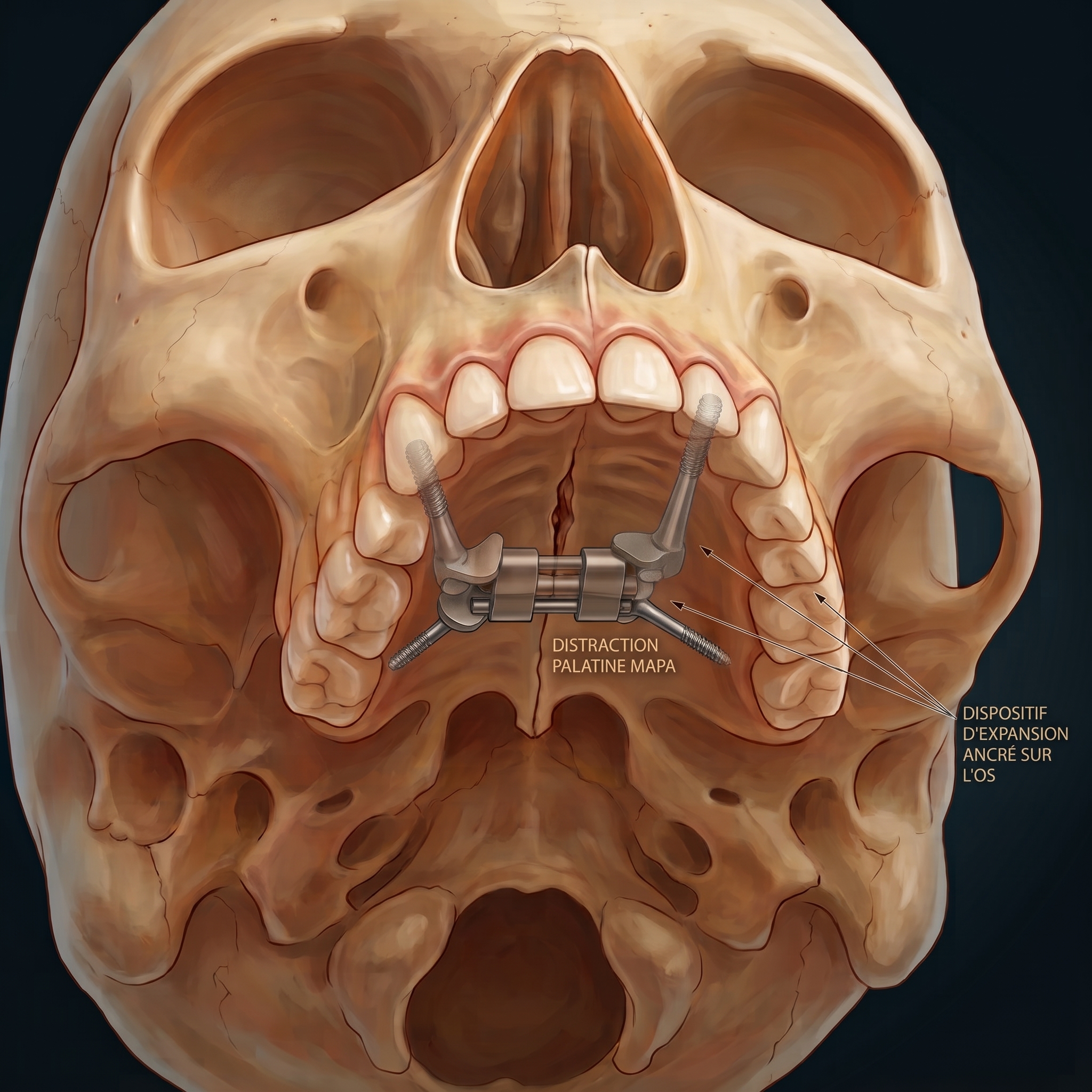
SARPE (surgically assisted rapid palatal expansion): minimally invasive osteotomies release the bony resistance of the upper jaw, then the expander gradually widens the palate. It is the reference technique in adults whose palatal suture has fused, especially when the deficiency is large.
DOME (distraction osteogenesis maxillary expansion): a bone-anchored expander is combined with targeted corticotomies. This approach was developed for certain patients with sleep apnoea, a narrow palate and nasal obstruction.
MARPE (miniscrew-assisted rapid palatal expansion): the expander is anchored in the palatal bone with miniscrews, without an osteotomy. It is mainly suited to adolescents at the end of growth and young adults whose suture can still open. In older adults, the suture may not give way and surgical assistance becomes necessary.
How the treatment unfolds
Before the operation: orthodontic assessment, 3D scan and fitting of the expander by the orthodontist.
The operation: performed inside the mouth, with no visible scar, usually under general anaesthesia, as a day case or with one night in hospital.
The latency phase: about a week of rest before activation begins, while healing gets under way.
The activation phase: the expander is activated every day, usually for 10 to 15 days and sometimes longer depending on the widening needed; a gap appears between the central incisors, the sign that the palate is widening.
Consolidation: the expander stays in place without activation for about 3 to 6 months while new bone forms and hardens, then it is removed at the practice.
Orthodontic follow-on: the orthodontist closes the gap between the incisors and aligns the teeth. Orthognathic surgery may complete the treatment if the jaws also need to be moved in other directions.
Recovery, complications and stability
Usual recovery: swelling of the face and upper lip for the first few days, moderate discomfort in the palate and a feeling of tension in the nose during activation, soft diet during this phase.
Possible complications, usually minor and temporary: nosebleed, pain, asymmetric or insufficient expansion, temporary reduced sensation in the upper lip or cheek, gum inflammation or recession, discomfort from the appliance.
Rarer complications: infection, loss of vitality or discolouration of a tooth, particularly the central incisors, heavier bleeding. Precise planning of the cut between the incisors limits these risks.
Stability: the widening of the bone is stable. Part of the widening measured at the teeth may decrease over time, which the orthodontist takes into account when finishing treatment. The result is generally considered stable after 6 to 12 months.
What the scientific literature says
The information on this page is based on Dr Yousefpour’s practice and on the maxillofacial surgery literature. Studies show that complications of surgically assisted palatal distraction are mostly minor and temporary, that the skeletal widening achieved remains stable over time, and that part of the widening measured at the teeth decreases, comparably to other expansion methods.
Williams B. J. et al., “Complications following surgically assisted rapid palatal expansion: a retrospective cohort study”, Journal of Oral and Maxillofacial Surgery, 2012.
Chamberland S., Proffit W. R., “Short-term and long-term stability of surgically assisted rapid palatal expansion revisited”, American Journal of Orthodontics and Dentofacial Orthopedics, 2011.
Teamwork with your orthodontist
Palatal distraction is a treatment carried out by two specialists. The orthodontist prepares and fits the expander, the surgeon releases the bone, then the orthodontist manages activation, consolidation and final alignment. Dr Yousefpour liaises with the orthodontist at every stage, from the initial assessment to the removal of the appliance.
Frequently asked questions
What is palatal distraction?
It is an operation that widens a palate that is too narrow. A minimally invasive procedure performed inside the mouth releases the bony resistance of the upper jaw; an appliance fixed to the palate, the expander, then gradually separates the two halves of the bone, which heal in their new position. It is also called surgically assisted rapid palatal expansion (SARPE).
Why surgery in adults, and not just a brace?
In children, the suture in the middle of the palate is still open and an orthodontic appliance is enough to widen it. In adults, this suture has fused: an appliance alone mainly tips the teeth outwards without widening the bone, with a risk to the gums. Surgery releases the bone so that the widening is truly skeletal.
How does it differ from MARPE?
MARPE uses an expander anchored in the palatal bone with miniscrews, without an osteotomy. It is mainly suited to adolescents at the end of growth and young adults whose suture can still open. In older adults, or when the deficiency is large, the suture may not give way and surgically assisted distraction becomes necessary. The choice is made with your orthodontist, after a 3D scan.
How does the treatment work?
The orthodontist first fits the expander. The operation then takes place inside the mouth, with no scar on the face. After a rest phase of about a week, the expander is activated every day, usually for 10 to 15 days and sometimes longer depending on the widening needed. It then stays in place for about 3 to 6 months while the bone consolidates. Orthodontic treatment then continues.
Is it painful?
Moderate discomfort in the palate and a feeling of tension in the nose are common during the activation phase. They are well controlled with ordinary painkillers. Expect some swelling and a soft diet for the first few days.
A gap is appearing between my front teeth: is that normal?
Yes. A gap opening between the two central incisors during activation is the sign that the palate is widening. The orthodontist closes it afterwards.
Does palatal distraction improve breathing?
By widening the upper jaw, the operation also widens the floor of the nasal cavity, which can improve nasal breathing in some patients. This benefit is not systematic. When it is considered for sleep apnoea, the indication is discussed after a sleep study.
Why see Dr Yousefpour for palatal distraction?
Dr Afshin Yousefpour has performed this operation for many years. His experience in jaw surgery was built in the United Kingdom, in leading hospital maxillofacial units, before his appointment as Consultant Specialist in 2006. He works closely with the orthodontist who treats you.