

Salivary gland surgery
Microsurgical precision: safety, function and appearance.
Duration
1 to 3 hours
Anaesthesia
General anaesthesia
Hospital stay
Usually 1 night
Recovery
Back to activities after 7 to 14 days, depending on the gland
The major salivary glands (parotid and submandibular glands) play a key role in lubricating the mouth and in digestion. When they are affected by tumours (benign or malignant), stones (salivary calculi) or recurrent chronic inflammation, targeted surgical treatment becomes essential.
Salivary gland surgery demands exceptional anatomical command, because major nerves lie immediately nearby, in particular the facial nerve and the motor branches of the tongue. Thanks to discreet, aesthetic approaches, optical magnification and real-time intraoperative nerve monitoring, operations are performed with strict respect for the function and appearance of the face.
Dr Yousefpour has considerable expertise in the anatomy and dissection of the facial nerve, and long experience of parotidectomy for parotid tumours, gained in particular in the head and neck oncology and reconstruction teams he led in the United Kingdom. His approach brings together three skills: separating the tumour from the branches of the facial nerve, reconstructing the defect left by the excision, and applying facial aesthetic surgery techniques for a scar that is as discreet as possible.
The protocol, step by step.
- Step 1
Advanced imaging
MRI, ultrasound or CBCT: precise definition of the lesion’s margins, its position in relation to the gland lobes and mapping of the vessels and ducts.
- Step 2
Cytology and histology
Biopsy or fine-needle aspiration when needed, to tailor the operation to the exact tissue type of the condition.
- Step 3
Dr Yousefpour’s clinical approach
Personalised planning of the surgical approach and preparation of micro-anatomical landmarks, to preserve motor nerve supply and optimise the scar.
Parotid gland surgery (parotidectomy)
The parotid is the largest salivary gland. The facial nerve runs through it, which calls for specific management; a full page is devoted to it: parotid tumours, parotidectomy and reconstruction of the defect.
Removal of the submandibular gland (submandibulectomy)
Lying beneath the edge of the lower jaw, the submandibular gland is surrounded by the marginal branch of the facial nerve (which lowers the corner of the mouth), the lingual nerve (sensation and taste in half of the tongue) and the hypoglossal nerve (tongue movement).
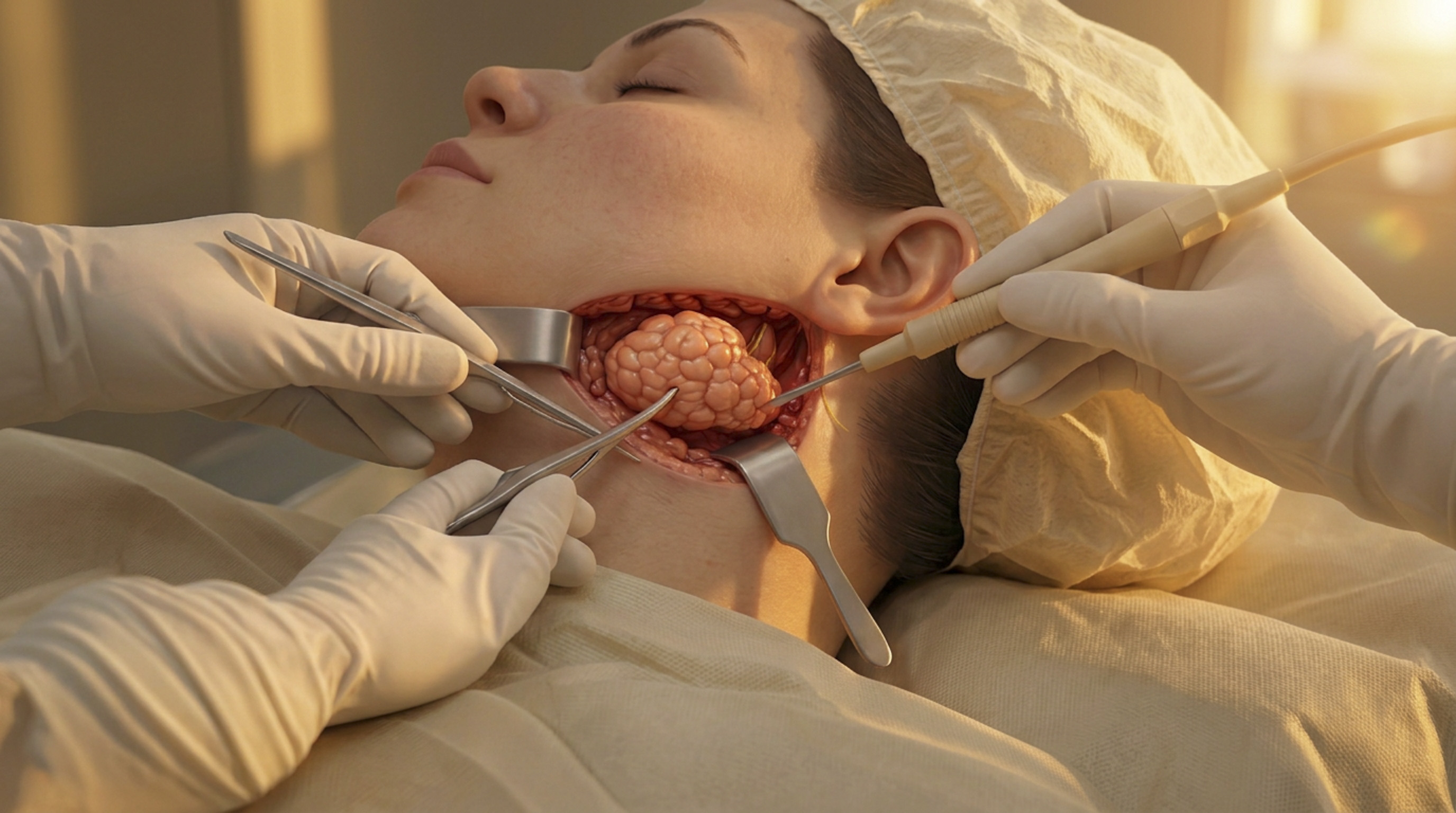
Indications: large obstructive salivary stones (that cannot be removed by sialendoscopy), recurrent chronic infections (sialadenitis), benign or malignant tumours of the submandibular region.
Dr Yousefpour’s particular expertise: a minimally invasive neck incision placed in a natural crease (at least 2 to 3 cm below the edge of the jaw) to hide the scar; fine subcapsular dissection and careful haemostasis, protecting the marginal branch of the facial nerve and the lingual nerve while the duct (Wharton’s duct) is released.
Recovery: moderate discomfort when swallowing for the first few days, well relieved by painkillers; swelling under the jaw for 7 to 10 days; removal of stitches or dissolvable stitches according to protocol; back to activities after 7 to 10 days.
Possible complications: haematoma in the neck, temporary weakness of the muscle that lowers the corner of the mouth (temporary asymmetric smile), temporary altered sensation of the tongue, minimal dry mouth (the other salivary glands fully compensate).
Informed consent: clarity and trust
Any operation on the salivary glands requires full and transparent information beforehand, so that you can approach treatment with peace of mind. At the dedicated pre-operative consultation:
We review your imaging together (ultrasound, MRI, CBCT) to see the lesion and its surroundings.
The operation, the aesthetic approach and the nerve-safety technology (monitoring) are explained to you step by step.
The usual recovery, post-operative follow-up and the risks specific to the gland and nerve anatomy are discussed clearly.
Time to reflect calmly
You receive a personalised information and informed consent form, giving you time to reflect calmly before any surgical decision.